How to negotiate Stripe fees, and what volume you need

In August 2026, Apple told a US court that Stripe's and Paddle's list prices are rates "which few, if any, large developers actually pay because they negotiate discounts" (court filing). Apple has its own reasons for saying that, but the point holds: Stripe's pricing page is where the conversation starts, not where it ends.
The questions are when it's worth asking, what you can realistically get, and what you might give up in return. I went through twelve years of Stripe's pricing pages and what companies have written about their own negotiations.
- Stripe hasn't published a volume threshold since 2020. The old ones were $80,000 to $100,000 a month in the US.
- Reported discounts are modest: 0.1 to 0.7 percentage points off the 2.9%, and the 30¢ usually stays.
- Bigger cuts and interchange-plus come around $1 million a month, often with a 36-month contract.
- A custom plan can add fees that are free on standard pricing. Price your whole fee schedule before you sign.
Stripe's own threshold, then and now
Stripe used to tell you when to ask. This is what its US pricing page said over the years, according to the Internet Archive:
| When | What stripe.com/pricing said |
|---|---|
| 2013 | "2.9% + 30¢ per successful charge, or less based on volume… Processing more than $1 million per year?" |
| 2014 to 2016 | "If you process more than $80,000 per month, get in touch" |
| 2016 to 2019 | No number. "Enterprise… Volume discounts… Contact sales" |
| 2019 to 2020 | "If you process more than $100,000 per month or have unique business needs" |
| 2021 to 2025 | No number. "Reach out to discuss alternative pricing options" |
| Today | "Stripe offers custom pricing for businesses with large processing volumes. Eligibility varies by market" |
Other countries had their own numbers. In Ireland it went from €20,000 to €30,000 a month between 2015 and 2017. In Denmark it was 600,000 kroner a month in 2015 (about €80,000) and 300,000 kroner (about €40,000) from 2017 until at least 2019.

Today's page lists what custom pricing can include: "IC+ pricing, discounted flat rates", and "Discounts based on volume tiers, commitments, and product usage". There's no number anymore, but the old ones are still a fair guide to when Stripe's sales team will take the conversation seriously.
What companies actually got
These are the deals I could find that companies wrote about themselves. Most are single reports, so read them as data points, not a price list.
| When | Volume | What they got | Source |
|---|---|---|---|
| 2014 | About $450K a month | 2.2% + 30¢ | Buffer |
| 2018 | About $80K a month | 2.6%, the percentage only | |
| 2019 | Over $100K a month | Offered 2.2%, with conditions (below) | GMass |
| 2023 | "$500k" (period not stated) | 0.1 percentage point off | |
| 2024 | About $1M a year | 2.9% down to 2.7%, 30¢ unchanged | |
| 2025 | A consultant's clients | 2.40% + 20¢, or interchange-plus at 0.22% + 15¢. Deeper cuts from $1M a month. All on 36-month contracts | Consultant |
Three patterns stand out.
Flat discounts cut the percentage, not the fixed fee. In 2017 Stripe's sales team told Gun.io that "our volume discounts apply to the percentage fee… fixed fee of 30¢ stays the same" (Gun.io). The fixed fee only comes down with interchange-plus and much higher volume.
Volume alone isn't always enough. Gun.io was turned down in 2017 while processing several times the $80,000 threshold, because about a quarter of its volume was American Express and a fifth was international cards (Gun.io). Both are expensive for Stripe.
The real money is at around $1 million a month. Below that, the reported discounts are a tenth of a point here and half a point there.
What a discount can cost you
The most useful report I found is from GMass in 2019. Stripe offered 2.2% instead of 2.9%, but the offer came with Stripe Billing at 0.4%, fees on refunds, an extra 1% on international cards and "a 36-month contract requiring me to bill through Stripe exclusively". The sales rep "could not tell me" whether it would actually save money, so GMass stayed on its old pricing.
Custom pricing still works that way. Stripe's pricing page says that on custom pricing "there may be fees for issuing refunds depending on your fee schedule". Some things that are included on standard pricing are charged separately, like 3D Secure at $0.03 per attempt and Authorization Boost at 0.2% per successful payment. A Stripe employee once described it as a plan that "unbundles our services" (Hacker News).
Two more things to weigh:
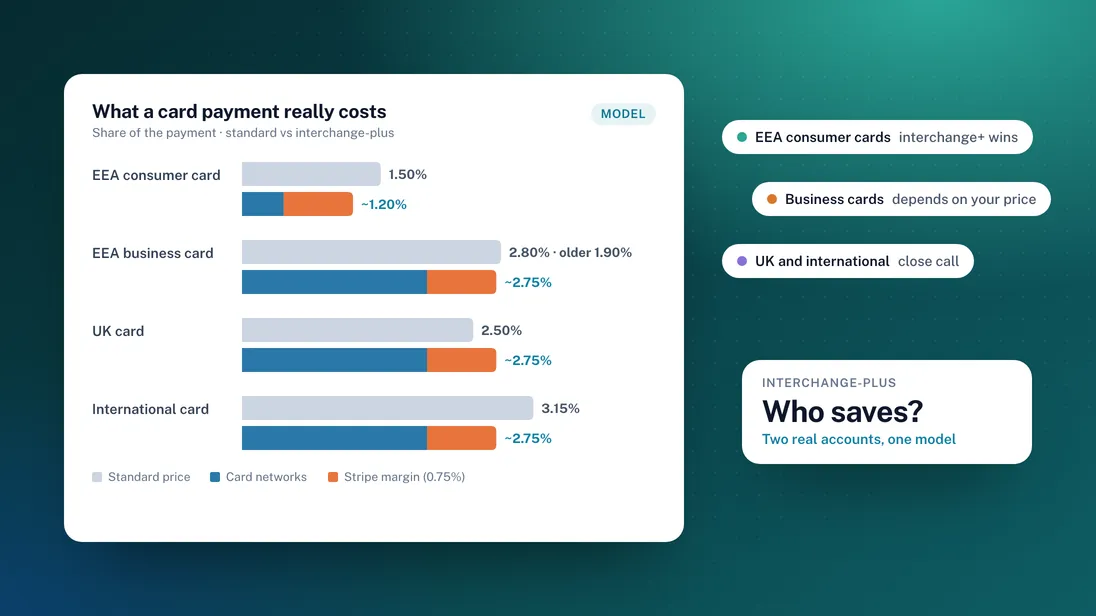
- Your current prices may be better than today's list prices. Stripe's list prices have mostly gone up. In the US, international cards went from 1% to 1.5% in 2023, Instant Payouts from 1% to 1.5% in 2024, and a second $15 fee for countering a dispute arrived in 2025. In Europe, premium cards went from 1.9% to 2.8% this summer. Older accounts sometimes keep older prices (I wrote about that in my post on interchange-plus), and a new agreement can replace them.
- Radar is changing. New Radar pricing takes effect on 22 January 2027 for accounts that have used it for free (Stripe). If fraud screening matters to you, put it on the table in the same conversation.
How I'd go about it
- Know your effective rate. That's your total Stripe fees divided by your volume, including everything around the card fee: international cards, currency conversion, Billing, disputes and refunds. It's the number to negotiate, not the 2.9%. GrowPanel's Payouts report shows it per fee type, and Insights tells you when it goes up and stays up, which is how you notice a quiet price change.
- Know your card mix. International cards, American Express and premium business cards cost Stripe more. If most of your payments are domestic consumer cards, you're a cheap customer to serve, and you should say so.
- Fix what doesn't need a negotiation. Currency conversion is often the biggest fee you can avoid on your own, by getting paid out in more currencies. Interchange-plus only pays off for some card mixes.
- Get a competing quote. Adyen publishes interchange plus 0.60% and $0.13 per payment for Visa and Mastercard, with a minimum invoice (Adyen). Braintree lists 2.89% + 29¢ in the US (PayPal). Reports go both ways: at one large e-commerce company, executives would take a competing deal to Stripe and say "match it or we're leaving", and Stripe matched (Hacker News), while another company was well over a point cheaper elsewhere and Stripe "wouldn't budge" (Hacker News).
- Ask for the whole fee schedule in writing. Every line, not just the headline rate: the fixed fee, international cards, currency conversion, refunds, disputes, Radar, 3D Secure, Billing, and the contract terms (length, minimums, exclusivity). Then price your last six months on both the old and the new schedule.
- Go through sales, and be patient. Use "Contact sales" on the pricing page, or your account executive if you have one. GMass had to escalate to Stripe's "Deal Desk" before it got a clear offer.
The bottom line
Below roughly $80,000 a month, you'll probably get little or nothing, and your time is better spent on the fees you can avoid yourself. Somewhere above that, a small cut to the percentage is realistic. Around a million a month, interchange-plus and real discounts are on the table, usually in exchange for a long contract. Whatever you're offered, compare your total cost on the whole fee schedule, not the headline rate.
You can see how fees show up in GrowPanel with sample data in the live demo.
Sources
Prices and wording as published in October 2026. Reports from companies are their own accounts, not Stripe's.
- Stripe's pricing page over time (Internet Archive): 2014, 2016, 2017, 2019, 2021, 2026. Ireland: 2015, 2017. Denmark: 2015, 2019
- Stripe price changes: US international cards and disputes (2023), Stripe Billing (July 2024), dispute fees (June 2025), Radar (January 2027), Stripe Connect
- Company reports: Buffer (2014), Gun.io, part 2 and part 3 (2017), GMass (2019), Merchant Cost Consulting (2025), and the Reddit and Hacker News threads linked above
- Alternatives: Adyen, Braintree, Checkout.com, Paddle
- Apple's statement: Epic v. Apple, filing of 13 August 2026

Founder & CEO
Lasse is the founder of GrowPanel. He previously founded Mouseflow, scaling it from $0 to $10M ARR before exiting. He also co-founded Soundvenue and actively invests in SaaS startups.
View full profile →