Stripe's 2% currency fee, and how Nordic SaaS can avoid it

If you run a SaaS company in Denmark, Sweden or Norway, there's a good chance most of your customers don't pay in your currency. They pay in euros, dollars and pounds, and Stripe quietly turns all of it into kroner before it reaches your bank.
That conversion has a price. On Stripe's pricing page for the Nordic countries it's one short line under the card fees: "+ 2% if currency conversion is required" (Stripe pricing, Denmark, as of October 2026). For a US business the same line says 1% (stripe.com/pricing). If half your revenue is foreign, that's 1% of everything you sell, every month, and it never appears as a fee next to a payment. It's simply a slightly smaller number in your balance.
I've spent a few weeks looking at this from two angles. One is the published prices: Stripe's settlement fees, the Nordic banks' currency margins, and the fintechs. The other is real data from two European SaaS companies whose Stripe accounts I've analyzed in GrowPanel, with their permission. I'll call them Account A and Account B. Most Nordic SaaS companies with foreign revenue can cut this cost by more than half, and some can make it disappear entirely. (Interchange-plus pricing is a story of its own, and the subject of my next post.)
- Stripe charges 2% to convert every foreign payment into your home currency (1% in the US), and it never shows up as a fee on a payment.
- Getting paid out in euros is free for Danish, Swedish and Norwegian Stripe accounts, and converting at a Nordic bank afterwards costs 0.4–1%. That's the biggest and easiest win.
- Dollars and pounds cost 1% to pay out, plus the bank's margin and a fixed bank fee for every payout, so each one only pays off above roughly €75,000 a year, on weekly payouts.
- The cheapest conversion is the one you never make: pay your foreign-currency bills with revenue in the same currency.
What Stripe does by default
Every Stripe account has a default currency. For a Danish company it's DKK, for a Swedish one SEK, and so on. When a customer pays in any other currency, Stripe converts the payment into your default currency when it settles into your balance. You pay the conversion fee, and you get Stripe's exchange rate, not the market's.
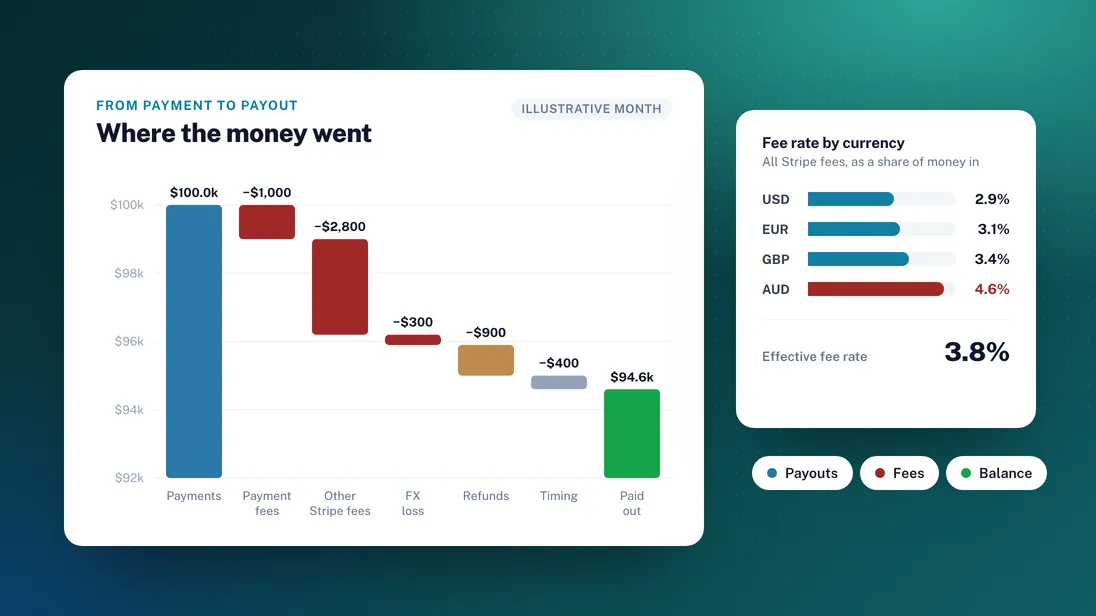
You rarely see this as a fee. The payment shows up in Stripe as €100 charged, and then as a kroner amount that's a bit lower than you'd expect from the day's exchange rate. In GrowPanel it's the FX loss row in the Cashflow report, and in the Payouts report it's its own fee type, Currency conversion.
How close is the real cost to the 2% on the pricing page? In Account A, which let Stripe convert everything until autumn 2024, the conversion cost came to 1.99% of the converted amount from January to September 2024. Account B still lets Stripe convert its euros and dollars, and over the last 12 months it paid 1.86%. So: about 2%, as promised.
Account A sells mostly abroad, so its currency costs were about 1.9% of all its revenue. Account B sells mostly at home, with 16% of its revenue in euros and dollars, so for Account B the cost is about 0.3% of revenue. Small, but as we'll see, half of it could go away with one free setting in Stripe.
Option 1: get paid out in more currencies
Stripe calls it multi-currency settlement. Instead of converting everything into kroner, Stripe keeps a separate balance in each currency you add and pays it out to a bank account in that currency. It's available for Stripe accounts in the EU (so Denmark and Sweden), Norway, Switzerland, the UK, the US and a few other countries, for up to 18 currencies. You add currencies yourself on the Balances page in the Stripe Dashboard, and you need a bank account in each currency you want paid out.
It isn't free for every currency. For a Nordic Stripe account, two currencies settle for free: your home currency and the euro. Every other currency costs 1% of what's paid out ("1% of pay out volume or a minimum fee", in the pricing page's words), and Stripe takes it when the money settles into that balance.
| Your Stripe account is in | Settles for free | Every other currency |
|---|---|---|
| Denmark | DKK, EUR | 1% |
| Sweden | SEK, EUR | 1% |
| Norway | NOK, EUR | 1% |
The table is in Stripe's docs under settlement pricing: pick your country, and EUR is listed as free next to your home currency. For Danish, Swedish and Norwegian accounts alike, the euro is free whatever your home currency is.
Account A is a Danish-krone Stripe account. Over the last 12 months it received 52 payouts in euros and 52 in kroner, and Stripe charged no settlement fee on any of them. On its pounds, dollars, Australian dollars and Swedish kronor, Stripe took exactly 1% every time.
There are a few practical details:
- Minimum payouts. When the bank account is outside the currency's home country, Stripe waits until the balance reaches a minimum before it pays out: $250 for USD and £200 for GBP into a Nordic bank account, for example. Euros have no minimum. If a currency is small for you, it'll sit in Stripe for a while.
- Bank accounts. Stripe needs a real bank account in each currency. Most Nordic business banks offer currency accounts, from free at Handelsbanken and Swedbank to about €90 a year at Danske Bank Sweden. Stripe also supports some "virtual" accounts such as Wise and Revolut, but its own documentation warns about a higher rate of failed payouts to them (Stripe payouts), and Wise only accepts Stripe payouts in some currencies.
- Refunds and disputes come out of the same currency balance, so a refunded euro payment is never converted twice.
- Bookkeeping. Every currency account is one more bank account to reconcile, its balance has to be revalued at the end of each period, and your auditor will want to see it too. With a bank feed into your accounting system it's a small job, but it isn't free.
Option 2: convert at your bank, or a fintech
Once the money is in a currency account, you decide when and where to convert it. And here the Nordic banks are surprisingly cheap compared with Stripe's 2%.

Of the big Nordic banks, only the Danish ones publish a margin in percent: 0.40% at both Nordea and Danske Bank. Danske Bank Sweden publishes its margin as an amount per euro, which works out at about 0.6%. Nordea Sweden and Norway, SEB, Swedbank, Handelsbanken and DNB publish only their daily buy and sell rates, so the striped bars are my estimate from those lists: the gap between a bank's buy rate and the midpoint of its buy and sell rates on 16 October. Treat them as a rough guide, and ask your bank for its margin in writing, with Stripe's 2% as your reference point.
| Provider | Converting EUR to the home currency | Fee per incoming transfer from abroad |
|---|---|---|
| Stripe, automatic conversion | 2% (1% for US accounts) | – |
| Nordea Denmark | 0.40% (0.428% with next-day value) | €8 (DKK 60); euros from the EU free |
| Danske Bank Denmark | 0.40% | Not published (it was DKK 50, about €7); euros from the EU free |
| Danske Bank Sweden | About 0.6% (SEK 0.065 per euro) | €4.50 (SEK 50); EU payments €0.17 |
| Nordea Sweden | Not published (about 1.0% from its rate list) | €5.40 (SEK 60); SEPA €0.17 |
| SEB | Not published (about 0.6% from its rate list) | €4.50–5.40 (SEK 50–60); SEPA €0.17 |
| Swedbank | Not published (about 0.75% from its rate list) | €3.60 (SEK 40); Europe payments €0.13 |
| Handelsbanken | Not published (rates only after login) | €5.40 (SEK 60); SEPA €0.13 |
| Nordea Norway | Not published (about 0.55% from its rate list) | €4.70–9.40 (NOK 50–100, by amount); SEPA €0.26 |
| DNB | Not published (about 0.45% from its rate list) | €4.70–9.40 (NOK 50–100, by amount); SEPA free |
| Wise Business | 0.43% into DKK (0.28% from USD, 0.32% from GBP) | About €60 to set up |
| Revolut Business | 0% within the plan's monthly allowance, then 0.6% (1% outside market hours) | Plans from about €11 a month |
| Airwallex | 0.5% for major currencies, 1% for others |
The banks' margins are on top of their own exchange rate, while the fintechs quote against the market rate, so they're close but not perfectly comparable. The point isn't to find the very cheapest provider. Any of them is a fraction of 2%.
Stripe doesn't charge anything for a standard payout. But your bank charges a fixed fee for every transfer it receives from abroad, whatever the amount: €4–9 at the big Nordic banks for dollars and pounds. Euro transfers from inside the EU (SEPA payments) are free or almost free. So every extra currency you settle in means one more bank fee per payout, and that's what decides when it pays off.
What it adds up to
Put the two together, and this is what bringing 100 of foreign revenue home costs a Danish company, by route:

Euros are the easy win. Settling in EUR is free and converting at the bank costs about 0.4%, so you save about 1.6% of your euro revenue from the very first euro. If you sell to customers in the eurozone and you're not doing this, it's the single cheapest change you can make.
Dollars and pounds are a smaller win. You pay Stripe 1% to settle them, plus the bank's margin when you convert, so the saving is about 0.6% instead of 1.6%. And because each payout lands as a separate transfer with its own bank fee, it only pays off above a certain volume.
When it pays off
Here's the same arithmetic as a break-even chart: what settling in a currency saves you per year, depending on how much revenue you have in that currency.

This is an illustrative model with published prices and €8 per incoming payout, which is what Nordea Denmark charges for each transfer in dollars or pounds (it's the bank's fee, not Stripe's). Here's the math behind the two break-even points:
- The saving is a percentage. Letting Stripe convert dollars or pounds costs 2%. Settling them costs 1% at Stripe plus about 0.43% at the bank, so 1.43%. That saves about 0.57% of your revenue in that currency.
- The bank fees are fixed. With weekly payouts that's 52 × €8 = €416 a year. With daily payouts it's about 250 × €8 = €2,000 a year.
- Break-even is where the two meet. €416 ÷ 0.57% ≈ €73,000 a year in that currency with weekly payouts, and €2,000 ÷ 0.57% ≈ €350,000 with daily payouts.
So the payout schedule matters a lot. With daily payouts, a currency needs around €350,000 a year before settling in it beats letting Stripe convert it. Switch it to weekly payouts (in Stripe's payout settings) and the break-even drops to around €73,000. The model leaves out bookkeeping, so if an extra currency account costs your bookkeeper an hour or so a month, add that to the fixed costs and the break-even moves up accordingly. For the euro it hardly matters, because the saving starts on the first euro, but for a small dollar or pound balance it can decide it.
Account A saw exactly this. Its smallest settlement currency, at a percent or two of revenue, saved almost nothing once the 1% settlement fee and the bank's fee per payout were paid. Its big currencies saved a lot.
A real example: from 1.9% to 1.2%
Account A gets most of its revenue in foreign currencies, mostly pounds and euros. Until September 2024, Stripe converted all of it into kroner. In October 2024 it switched to settling in each currency and converting at its bank.

Before the switch, currency conversion cost about 1.9% of all customer payments. After it, Stripe's settlement fee is about 0.8% of payments (1% on everything but the euros), and the bank's margin adds an estimated 0.4%, so about 1.2% in total. The bank's part is an estimate because it happens outside Stripe, but it's based on the bank's published margin.
That's 0.7% of revenue saved, every year, for a change that took an afternoon: open currency accounts at the bank, add the currencies in Stripe, done.
Account B, the one that still lets Stripe convert, has a simpler opportunity. About 10% of its revenue is in euros. Settling those in EUR would cost nothing at Stripe and about 0.4% at the bank, which would cut its total currency costs roughly in half. Its dollars, at around 5% of revenue, are close to the break-even line, so those could stay as they are.
The smartest conversion is the one you never make
Here's the part most founders miss. If you have costs in a foreign currency, and almost every SaaS company does (cloud hosting, software subscriptions, ads, contractors abroad), you're probably converting twice: Stripe turns your customers' dollars into kroner at 2%, and then your bank or card turns kroner back into dollars to pay AWS.

If you settle in that currency and pay those bills straight from the currency account, the money is never converted at all. For dollars you pay Stripe's 1% settlement fee and nothing else. For euros, it's free.
This is what treasurers call natural hedging. UBS's guide to currency hedging for small businesses puts it simply:
"…adjust your value chain so that expenses and revenues in a foreign currency balance each other out." – UBS
It also adds the honest caveat that in reality the flows rarely balance out completely, and that's fine. Every dollar you don't convert is a dollar you don't pay for. And Stripe describes multi-currency settlement in almost the same words: balances "to pay suppliers, process refunds, and avoid FX fees".
There's a second benefit beyond the fees. When your revenue and your costs are in the same currency, a sudden move in the exchange rate hits both sides at once, so it hurts much less. For a Danish company holding euros this barely matters, because the krone is pegged to the euro and can only move 2.25% either way (Danmarks Nationalbank). For a Swedish or Norwegian company, whose currencies float freely, it matters a lot more.
A few practical ways to do it:
- Pay your biggest foreign-currency bills from the matching account, by bank transfer or with a card that spends from that balance.
- Pay contractors and partners abroad in their own currency from the same balance.
- Keep a buffer. Only convert what's left over after your foreign bills, and do it in larger, less frequent batches.
Which of your bills can you move?
There's a catch. Several of the biggest SaaS costs bill a Nordic company in its home currency, and paying a krone invoice with a euro card doesn't help: your card issuer just converts the kroner instead. The invoice itself has to be in euros or dollars. Here's how the usual vendors handle it for a Danish company (Sweden and Norway work the same way), as of October 2026:
| Vendor | Billing currency for a Danish company | Can you change it? |
|---|---|---|
| Google Ads | DKK, EUR or USD | Only when you create the account. To change it, you open a new account, and the history doesn't move |
| Meta Ads | DKK, EUR, USD and others | Once every 60 days, with no open balance, and it creates a new ad account. Not on monthly invoicing |
| LinkedIn Ads | DKK, EUR, USD and others | Only at creation, but you can run one ad account per currency |
| Microsoft Advertising | DKK, EUR, USD and others | Only at creation, one account per currency |
| AWS | USD by default; EUR, DKK, SEK, NOK and others | Any time, in your payment preferences |
| Google Cloud | DKK | No. It follows your billing country |
| Azure and Microsoft 365 | DKK | No. It follows your legal address |
| Google Workspace | DKK, EUR, USD or GBP | Chosen at setup. You can switch from EUR or USD to DKK later, but not back |
| Hetzner | EUR or USD | Only at account creation |
| Scaleway | EUR | – |
| DigitalOcean, Vercel, GitHub, Atlassian, Intercom, the OpenAI API | USD | No |
| Zoom | DKK, EUR or USD | Once, in the billing portal |
| Figma | EUR or USD | At checkout |
Three things follow from that:
- Choose the currency when you create an account. Google Ads, LinkedIn and Microsoft Advertising lock it forever. If a lot of your revenue is in euros, start new ad accounts in euros, but weigh that against losing the account history.
- AWS is the easy one. Switch the payment currency to dollars or euros and pay it from the matching balance. AWS builds its own conversion margin into the exchange rate, so this saves on both sides.
- USD-only tools need a card that spends dollars. If your bank can't issue a card on its USD account, business cards from Revolut, Airwallex and Pleo spend from a matching currency balance first.
What I'd do
| If you… | Then… |
|---|---|
| Have any revenue in euros | Add EUR as a settlement currency and open a EUR account. It's free at Stripe and saves about 1.6% of that revenue |
| Have more than about €75,000 a year in USD or GBP | Settle in it, switch that currency to weekly payouts, and convert at your bank or a fintech |
| Have less than that in a currency | Let Stripe convert it, unless you have bills to pay in that currency |
| Pay vendors or contractors in a foreign currency | Settle in that currency and pay them from it. That's the cheapest conversion of all |
| Are in Sweden or Norway | Ask your bank for its business currency margin, and think about currency risk as well as fees |
None of this needs a treasury department. It's a few currency accounts, a few settings in Stripe and a habit of checking what each currency actually costs you.
Know what each currency costs you
That last part is the hard bit. Stripe shows conversion as a slightly smaller balance and settlement fees as separate lines in your balance history, so it's surprisingly hard to answer a simple question like "what did our pounds cost us last quarter?"
This is exactly why we built the Payouts report in GrowPanel. Group the Fees tab by currency and switch to percentages, and each currency gets its own fee rate: everything Stripe charged on that currency's payments, as a share of the money that came in. Conversion shows up as its own fee type, Currency conversion, and settlement fees as Payout fees, so if you switch a currency to its own settlement, you can watch one go down and the other go up, and see whether the trade was worth it.

The bottom line
For most Nordic SaaS companies, Stripe's default is the most expensive way to get paid in foreign currencies, and the fix is refreshingly boring: a euro account at your bank and one setting in Stripe. Settle in euros first. Add dollars and pounds once each is big enough to carry its own bank fees, and switch them to weekly payouts. And wherever you can, pay foreign bills with foreign revenue, so the money is never converted at all.
Account A cut its currency costs from about 1.9% to about 1.2% of revenue that way, and Account B could halve its own with one free setting. Neither needed a treasury department, just a clear view of what each currency actually costs.
You can see how that looks with sample data in the live demo, where the Payouts report has every fee type and currency.
Sources
All prices as published in October 2026.
- Stripe: pricing for Denmark, US pricing, multi-currency settlement and payouts
- Danish banks: Nordea's currency margins and business price list, Danske Bank's currency margins
- Swedish banks: Danske Bank Sweden's margins and price list, Nordea Sweden's price list and rates, SEB's prices, Swedbank's rates, Handelsbanken's price list
- Norwegian banks: Nordea Norway's prices, DNB's prices and rates
- Fintechs: Wise Business pricing, Revolut Business plans, Airwallex pricing
- Hedging: UBS, currency hedging for businesses, Danmarks Nationalbank, fixed exchange rate policy
- Account A and Account B: real Stripe data from two European SaaS companies, analyzed in GrowPanel with their permission and shown as percentages only

Founder & CEO
Lasse is the founder of GrowPanel. He previously founded Mouseflow, scaling it from $0 to $10M ARR before exiting. He also co-founded Soundvenue and actively invests in SaaS startups.
View full profile →